
Specialized publications on line
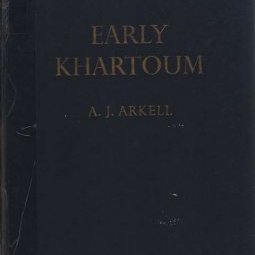
Early Khartoum
A.J. Arkell excavated in 1944 near modern Khartoum a Mesolithic site, with the remains of a culture which he called ’Early Khartoum’. No traces of houses or huts were found but the remains excavated must belong to a settlement at least occasionally inhabited. Early Khartoum is a Mesolithic culture with some bone working and a microlithic stone industry. The use of pottery perhaps indicates contacts with Neolithic cultures. There was a limited use of wild grain. From the faunal remains it seems certain that these people lived by hunting and fishing; no domesticated animals were found.
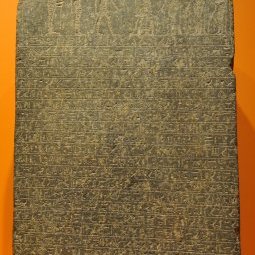
L’écriture méroïtique
Synthesis of the principles of Meroitic writing and its appearance.
Click on the PDF attached to access to work.

The quest for water and the diffusion of Northern East Sudanic languages from the fourth to the first millenia BCE
From the Yellow Nile to the Blue Nile.
This lecture was delivered in ECAS 2009 (3rd European Conference on African Studies, Panel 142: African waters - water in Africa, barriers, paths, and resources: their impact on language, literature and history of people) in Leipzig, 4 to 7 June 2009.
Royal Cemeteries of Kush
RCK
The five volumes of the Royal Cemeteries of Kush are now available online. Please click on the following files to download.
Meroitic Newsletters
MNL
The Meroitic Newsletters are now available online. Please click on the associated PDF files to download.
Archaeological Survey of Nubia
ASN
The six volumes of the Archaeological Survey of Nubia are now available online.
Dotawo 3
The third volume of Dotawo, guest-edited by Marc Maillot, is dedicated to Know-Hows and Techniques in Ancient Sudan. This collection of articles is the result of a workshop held at Lille University on September 5 and 6, 2013, which brought together several Sudanese archaeology scholars, from architecture to iron production through pottery and textile industry.
Fouilles d'Oxford en Nubie
L’Université Oxford a organisé une série d’expéditions au sud de l’Égypte et du Soudan à partir de 1910, dirigée et financée en grande partie par Francis Lewellyn Griffith, le premier professeur d’égyptologie à Oxford. Les travaux ont été effectués entre 1910 et 1913, puis de 1929 à 1931 dans des sites tels que Faras, Kawa et Sanam. Après la mort de Griffith en 1934, Sir Laurence Kirwan dirige les fouilles d’Oxford à Firka (1934-1935) et à Kawa (1935-1936).
Ballana/Qustul
Ballana was a cemetery in Lower Nubia. It was excavated by Walter Bryan Emery between 1928 and 1931 as a rescue project before the construction of the high dam at Aswan. A total of 122 tombs were found under huge artificial mounds. They date to the time after the collapse of the Meroitic state but before the founding of the Christian Nubian kingdoms, around AD 350 to 600. They usually featured one or several underground chambers, with one main burial chamber. Some tombs were found unlooted, but even the robbed burials still proved to contain many burial goods.
Karanog
In Sudanese Nubia, L. Woolley and D. R. MacIver were the first to undertake an excavation program of a Meroitic city and its associated cemetery at the site of Karanog. This excavation of the University of Pennsylvania in 1909 documented the Meroitic architecture in a still unstudied area and describes an archaeological material that differs from the sites of the Butana region.
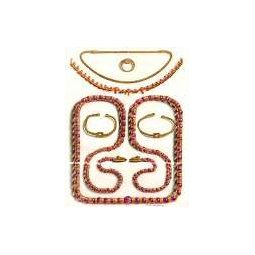
Buhen
Buhen was an ancient Egyptian settlement situated on the West bank of the Nile below the Second Cataract. On the East bank, across the river, was located an ancient settlement of Wadi Halfa. Buhen is known for its large fortress, probably constructed during the rule of Senusret III in around 1860 BC (12th dynasty). Senusret III conducted four campaigns into Kush and established a line of forts within signalling distance of one another; Buhen was the northernmost of these. The other forts along the banks were Mirgissa, Shalfak, Uronarti, Askut, Dabenarti, Semna, and Kumma. The fortress at Buhen is now submerged under Lake Nasser as a result of the construction of the Aswan Dam in 1964.
Excavations at Kerma
Harvard African studies
George Andrew Reisner
Egyptian Expedition of Harvard University and the Boston Museum of Fine Arts
Peabody Museum of Harvard University, 1923
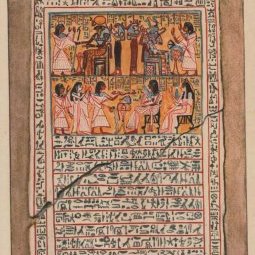
Aniba
Steindorff G. Aniba. Vols. I-III, J.J. Augustin, Glückstadt-Hamburg, 1935, 253 pages, 98 plates. First Edition.
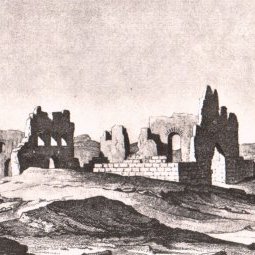
Aksha
The excavation of the archaeological site of Aksha, otherwise known as Serra West or Serreh, is composed of three campaigns, held between 1961 and 1962. The operations concentrated on a Ramesside temple and the adjoining Christian remains; a Meroitic necropolis northwest of the temple; and a small habitat site dated Group C.
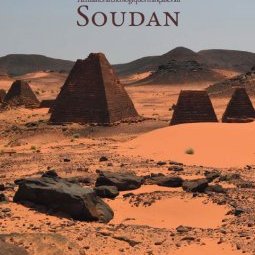
Routes de l'Orient
The third Hors-Série de “Routes de l’Orient” on French archeology in Sudan is available, in partnership with the SFDAS.
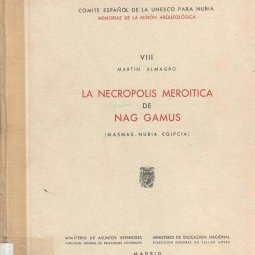
SFDAS 50th anniversary
SFDAS continues its program on open archives. We propose today the book of M. Almagro, the meroitic necropolis of Nag Gamus, 1965.
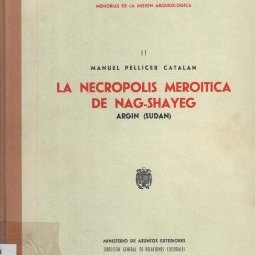
Nag Shayeg
Spanish archaeological mission from the UNESCO commitee in 1960. Meroitic Necropolis in the Argin region, with more than 220 graves.
Latest releases

Palaces and large residences of the Meroitic Kingdom
"Palaces and large residences of the Meroitic Kingdom", by Marc Maillot, Sorbonne University Press/SFDAS editions. Two volumes, 64 euros.
Funerary customs in the kingdom of Meroe
Vincent FRANCIGNY Paris, Editions Boccard, 2017 ISSN 2101-3195 - ISBN 978-2-7018-0520-7
History and civilizations of Sudan
The pyramids of Meroe made generations of travelers dream, but Sudan of which they are the emblem remains largely unknown. Hence this encyclopedic work, the first synthesis of (...)